



Amazon’s Agentic AI Revolution: Redefining Cloud, Retail, and Operations
-
admin / 9 months

- December 15, 2025
- 0
- 4 min read
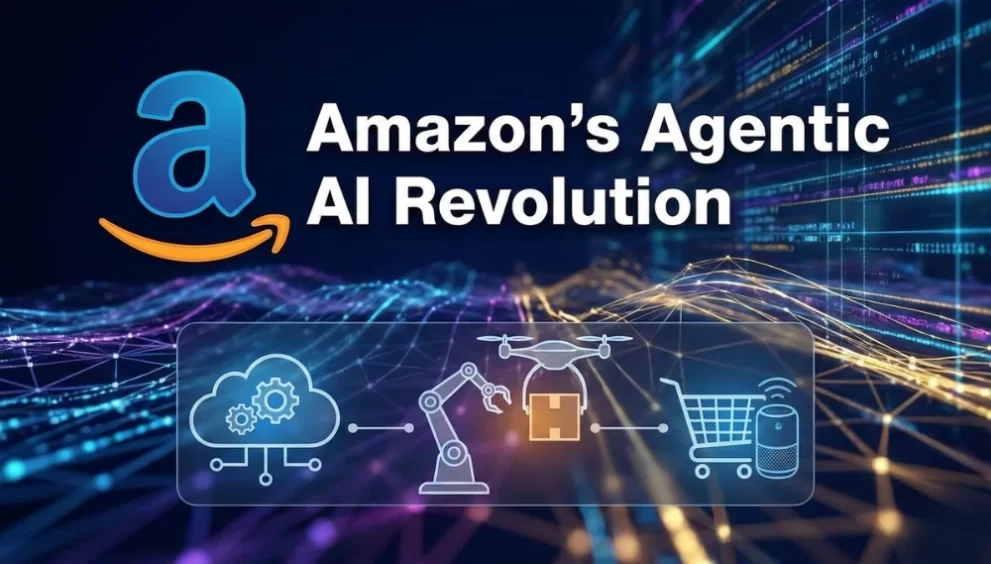
In 2025, Amazon has solidified its position as a pioneer in artificial intelligence, transitioning from generative AI tools to agentic AI autonomous systems capable of planning, reasoning, and executing multi-step tasks independently. This shift positions agentic AI as a foundational “control plane” for autonomy across Amazon’s vast ecosystem, encompassing AWS cloud infrastructure, e-commerce, logistics, and consumer devices. As the company that ignited the cloud computing era, Amazon’s aggressive adoption of agentic AI not only drives internal efficiencies but also sets a blueprint for enterprises worldwide.
The momentum began early in the year when AWS formed a dedicated agentic AI group in March 2025, led by veteran executive Swami Sivasubramanian. AWS CEO Matt Garman described agentic AI as a potential “multi-billion business,” emphasizing its role in enabling customers to automate complex workflows. This internal restructuring underscored Amazon’s commitment, culminating in major announcements at AWS re:Invent 2025, where Amazon Bedrock AgentCore emerged as the cornerstone platform for building, deploying, and scaling secure AI agents.
AWS Bedrock AgentCore: The Enterprise Foundation for Agentic AI
At the heart of Amazon’s strategy is Amazon Bedrock AgentCore, launched in preview mid-year and reaching general availability by late 2025. AgentCore provides modular building blocks, including runtime hosting, memory, observability, evaluations, and policy controls for creating production-ready agents. Key enhancements announced at re:Invent include Policy features that allow natural-language boundaries on agent actions (e.g., limiting refunds to $100 without human approval) and advanced evaluations for real-world performance monitoring.
AgentCore integrates seamlessly with tools like Amazon Bedrock Knowledge Bases and third-party services (Salesforce, Slack), offering auditability and governance essential for enterprises. As highlighted in AWS announcements, it supports long-running “frontier agents” that operate autonomously for hours or days, transforming software development, security, and operations. Customers like MongoDB and PGA TOUR have already deployed AgentCore-powered solutions, accelerating agent adoption while ensuring compliance.
This platform positions AWS as the default infrastructure for supervised enterprise agents, addressing pain points like security and scalability that have hindered widespread deployment.
Internal Transformations: Workforce and Operations
Amazon’s CEO Andy Jassy candidly addressed the human impact of AI in a June 2025 memo, stating that generative AI and agents would automate routine tasks, leading to slower hiring, role shifts, and a net reduction in corporate workforce over coming years. Jassy noted, “We will need fewer people doing some of the jobs that are done today,” while emphasizing growth in AI governance and design roles. This followed massive investments in over 1,000 internal gen AI applications targeting high-volume workflows like inventory optimization and customer service.
In logistics, Amazon unveiled three AI innovations in June 2025: Wellspring, a generative AI mapping system improving delivery accuracy by integrating satellite imagery and customer data; an advanced demand forecasting model predicting regional preferences with 20% greater accuracy; and agentic AI for robotics enabling natural-language commands. These tools have reduced mis-deliveries, optimized inventory, and enhanced warehouse efficiency, contributing to faster deliveries and lower costs.
Consumer-Facing Agents: Alexa+ and Rufus
Agentic AI extends to consumers through upgraded assistants. Alexa+, launched in early 2025, introduces autonomous capabilities like monitoring price drops across wish lists and automatically purchasing items within user-set thresholds. This “Buy for Me” feature, expanded to over half a million products by year-end, exemplifies bounded autonomy, agents acting on predefined constraints while handling transactions.
Complementing Alexa+ is Rufus, Amazon’s AI-powered shopping assistant in the app and website. Updated throughout 2025 with over 50 enhancements, Rufus now features persistent memory (recalling user preferences), visual search (uploading handwritten lists), price tracking, and auto-buying. It provides personalized comparisons, deal recommendations, and even adds items to carts based on context. Rufus has driven significant engagement, with users 60% more likely to purchase and contributing to projected $10 billion in incremental sales.
These consumer agents shorten the path from intent to purchase, blending personalization with autonomy for seamless experiences.
Governance, Future Outlook, and Industry Implications
As agentic AI matures, Amazon prioritizes “managed AI” with mechanisms for permissions, monitoring, and escalation. AgentCore’s observability dashboards and policy enforcement ensure agents adhere to guidelines, mitigating risks like unauthorized actions.
Looking ahead, Amazon’s investments, bolstered by custom chips like Trainium3 and Nova models, signal sustained leadership. While workforce adjustments draw scrutiny, the focus on upskilling and new roles reflects a balanced approach.
Amazon’s 2025 agentic AI advancements demonstrate how integrating autonomy across operations yields massive efficiency gains. From AWS’s enterprise tools to consumer innovations, the company is not just adopting AI it’s architecting the agentic future, proving that small automations in high-volume areas can transform giants.