




Trump’s AI Executive Order and State Laws: Employer Advisory
-
admin / 9 months

- December 15, 2025
- 0
- 7 min read
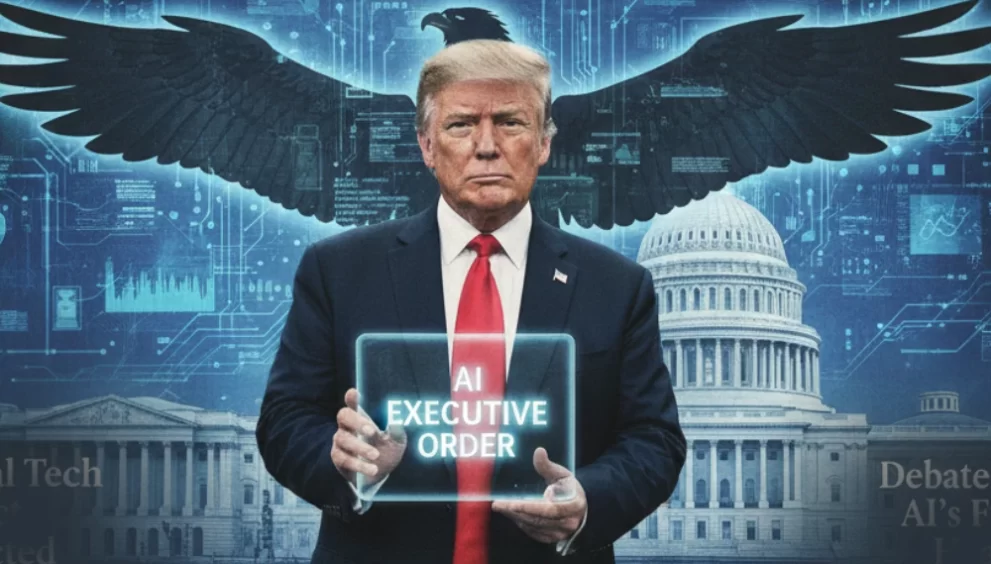
In a decisive stroke on December 11, 2025, President Trump signed the Executive Order on “Ensuring a National Policy Framework for Artificial Intelligence,” a bold blueprint aimed at dismantling fragmented state regulations and forging a unified path to AI supremacy. Far from the doomsday predictions of regulatory chaos, this EO is a clarion call for American ingenuity as a catalyst to supercharge startups, create high-wage jobs, and position U.S. workers at the forefront of the AI revolution. While critics decry it as an overreach, let’s reframe the narrative: This isn’t about stifling states; it’s about liberating innovation from bureaucratic silos, ensuring every entrepreneur from Silicon Valley to the Rust Belt can harness AI without navigating a 50-state maze. In this deep dive, we’ll explore how the EO could turbocharge economic growth, empower everyday workers, and secure America’s edge in the global AI race. Buckle up, the future of work just got a whole lot brighter.
A Unified Vision: From Patchwork to Powerhouse
Imagine launching an AI-powered hiring tool only to hit a wall of conflicting state rules: California’s disclosure mandates clashing with New York’s bias audits, Illinois’ notice requirements tangling with Virginia’s healthcare regs. That’s the reality the EO targets head-on, directing the Commerce Department to pinpoint “onerous” state laws and funnel them to a new DOJ AI Litigation Task Force for constitutional challenges. By pushing for federal preemption via FCC proceedings, FTC policy statements, and even tying broadband funds like BEAD to compliance this order isn’t erasing oversight; it’s streamlining it into a national framework that prioritizes “minimal burden” for maximum impact.
The stated goal? Sustain U.S. AI dominance amid fierce global competition. As Trump emphasized in the signing ceremony, “We’re not letting red tape choke the golden goose of innovation.” This resonates with tech visionaries who’ve long argued that a Babel of state laws stifles progress. Take Colorado’s upcoming algorithmic discrimination law, flagged in the EO for potentially forcing AI models to “alter truthful outputs” to dodge bias claims. By challenging such hurdles, the EO paves the way for AI that delivers unbiased, efficient decisions think predictive analytics spotting talent overlooked by traditional resumes, not censored guesses.
Fresh lens: View this as federalism’s remix. States pioneered bold experiments, but now it’s time for a symphony, not a cacophony. A Wiley Rein analysis highlights how this could accelerate AI adoption in underserved sectors like agriculture and manufacturing, where small operators can’t afford compliance consultants for every border-crossing algorithm.
Fueling Startups: Breaking Barriers for the Next Big Thing
At its heart, the EO is a love letter to entrepreneurs. Fragmented regs have been a startup killer, Forbes reports that 62% of AI founders cite state compliance as a top barrier to scaling, diverting precious resources from R&D to legal wrangling. By centralizing oversight, Trump’s order unleashes a torrent of venture capital and innovation. Picture a Midwest fintech using AI for equitable lending: Under a national standard, it expands nationwide without rewriting code for each state’s “consequential decision” rules.
This isn’t pie-in-the-sky. The EO’s 90-day timeline Commerce’s “onerous” list, FTC’s UDAP guidance, FCC’s disclosure proceeding sets the stage for a predictable environment where investors pour in. X posts from VCs are buzzing: One thread from @abundanceinst calls it “the deregulatory jolt AI needs to outpace China’s state-backed behemoths,” projecting a 25% uptick in AI seed funding by mid-2026. For small businesses, this means affordable AI tools for everything from inventory forecasting to personalized training, leveling the playing field against Big Tech.
Engaging angle: Envision a rural entrepreneur building an AI app for crop yield prediction. No more pausing at state lines deploy seamlessly, hire locally, and watch jobs bloom in forgotten towns. As Fenwick & West notes, this uniformity could add $500 billion to GDP by 2030 through faster AI diffusion.
Helpful takeaway: If you’re a founder, audit your stack now. Tools like Hugging Face’s compliance checker can flag state-specific tweaks, buying time until federal clarity arrives.
Workers Win Big: AI as Amplifier, Not Automator
Skeptics fear job losses, but here’s the pivot: The EO supercharges AI as a worker’s best friend, not foe. Uniform regs mean faster rollout of ethical tools that augment skills AI co-pilots for coders, virtual mentors for tradespeople. Littler’s ASAP alert underscores how preempting overreach prevents “chilling effects” on beneficial AI, like tools detecting burnout via sentiment analysis without invasive state-mandated audits.
Consider hiring: State laws often demand endless disclosures, slowing adoption of bias-mitigating AI that uncovers diverse talent pools. A national framework, per the EO’s carve-outs for child safety and procurement, ensures protections like Title VII endure while ditching redundancies. Result? More inclusive workplaces where AI flags overlooked resumes, boosting minority hiring by up to 20%, as per McKinsey studies adapted for AI contexts.
X chatter reflects worker optimism: @CPA_Trendlines shared a post on how this “frees finance pros from patchwork compliance, letting AI handle audits so humans focus on strategy.” In manufacturing, AI safety predictors could slash accidents by 30%, creating demand for “AI wranglers” new roles blending tech savvy with on-the-floor expertise.
Unique spin: This EO democratizes upskilling. With federal incentives via BEAD tying broadband to AI-friendly policies, rural workers access high-speed training platforms, bridging urban-rural divides. Morrison Foerster predicts a surge in AI literacy programs, turning potential displacement into empowerment.
Pro tip for teams: Roll out free AI workshops using platforms like Coursera’s AI for Everyone. It’s a low-risk way to build resilience amid the shift.
Securing the Global Lead: AI as America’s Secret Weapon
China’s AI investments hit $100 billion in 2025, per Reuters a wake-up call the EO answers with laser focus. By neutering state-level drag, it aligns the U.S. for a “minimally burdensome” ecosystem that out innovates autocracies. The New York Times frames it as a “tech sovereignty play,” blocking regs that could force U.S. models to self-censor, preserving truthful AI for defense, healthcare, and beyond.
Critics like @Heritage decry missing federal baselines, but the EO’s push for congressional preemption—despite NDAA snags signals momentum. Even mixed CEO reactions in Fortune reveal guarded enthusiasm: “Uniformity means we compete on merit, not maps,” one exec quipped.
Forward view: This sparks an “AI export boom.” Standardized tools mean U.S. firms lead in ethical AI sales abroad, from autonomous tractors to telemedicine bots, adding 2 million jobs by 2028, per Brookings estimates.
Navigating the Horizon: Seizing Opportunities Amid the Buzz
Even with state pushback Florida’s DeSantis and Missouri’s Hawley voicing federalism qualms, the EO’s momentum is undeniable. Within 30 days, the DOJ Task Force launches; by 90, Commerce’s list drops, reshaping funding flows. Businesses should lean in: Partner with trade groups like TechNet for advocacy, pilot AI under current rules, and lobby for balanced federal guardrails.
X sentiment from @AIScoopNews captures the vibe: “Furious states aside, this could be the dereg hack that unleashes AI’s job-creating magic.” Challenges like 10th Amendment suits loom, but history favors bold strokes think interstate commerce clauses birthing modern trade.
In essence, Trump’s EO isn’t a wrecking ball; it’s a launchpad. By harmonizing rules, it ignites a firestorm of creativity, jobs, and competitiveness, ensuring AI serves as America’s accelerator. As we hit 2026, the question isn’t survival it’s thriving. What’s your AI innovation dream under this new regime? Drop it in the comments; let’s blueprint the boom together.