




AI Stocks Jump as Investors Bet Big on 2026 Growth
-
Avick kumar Dey / 9 months

- January 3, 2026
- 0
- 4 min read

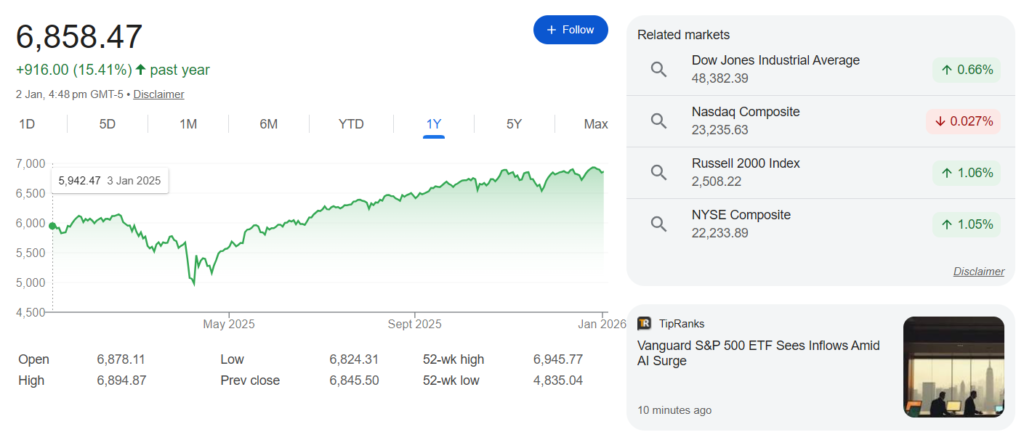
U.S. stocks are launching into 2026 with echoes of 2025’s momentum, as artificial intelligence continues to captivate investors. On the opening trading day, AI-linked stocks soared, propelling a mixed session across the major indices. The S&P 500 advanced 1.2%, the tech-dominated Nasdaq edged down 0.2%, and the Dow Jones Industrial Average gained 0.7%, or about 295 points.
The AI surge, which drove substantial market gains throughout 2025, shows no signs of fading and is poised to dominate headlines in the coming year, though debates about its sustainability persist. Market watchers are also eyeing resilient global economic expansion and anticipated interest rate reductions as key drivers for U.S. equities. “2025 marked a robust year for diverse asset classes, including equities, fixed income, and emerging markets, bolstered by steady growth, AI enthusiasm, and easing monetary policies from central banks,” noted Deutsche Bank’s global macro strategist Jim Reid in a recent note.

This sentiment is echoed across Wall Street. In a comprehensive survey of analysts from leading institutions, all participants forecast gains for the S&P 500 in 2026, with an average expected rise of around 10% aligning closely with the index’s long-term historical average. This would build on 2025’s impressive 23% advance for the S&P 500, despite headwinds from geopolitical tensions and shifting trade dynamics. Notably, the index achieved its fourth consecutive year of positive returns, largely thanks to the explosive growth in AI technologies. S&P 500 closes lower Wednesday, but wraps 2025 with a 16% gain.
Several AI powerhouses kicked off the year with strong performances. Nvidia, Broadcom, and Micron Technology led the pack, posting gains fueled by breakthroughs in AI chip efficiency and announcements of major data center expansions in Europe and Asia. Broadcom, in particular, has seen its shares more than double over the past year, underscoring the sector’s voracious demand for advanced semiconductors. The rise of AI infrastructure is also creating ripple effects, such as booming demand for skilled trades in data center construction, with electricians and engineers seeing unprecedented job growth opportunities.
Beyond tech, other sectors benefited from policy shifts. Electric vehicle manufacturers like Tesla and Rivian climbed sharply after the administration extended incentives for domestic battery production, averting potential supply chain disruptions. In consumer goods, companies such as Lowe’s and Home Depot rallied on delayed import duties for building materials, providing relief amid ongoing housing market pressures.
Precious metals, which delivered their strongest annual returns in decades during 2025, started 2026 on a positive note before paring gains. Gold, up over 27% last year, dipped slightly by session’s end, while silver, which surged 29%, held onto a 2.1% advance. Crude oil prices eased modestly, extending 2025’s significant decline the largest since 2020 which has helped keep inflation in check and lowered average gasoline prices to $2.75 per gallon, per AAA data.
Trading volumes remained subdued due to the holiday period, a typical pattern that often amplifies short-term swings. Despite U.S. equities’ solid 2025 run, they were outshone by international markets for the first time in years, with the MSCI All Country World ex-USA index soaring over 25% the widest gap since 2010. Emerging markets shone brightly: India’s Sensex jumped 35% on tech and infrastructure booms, while Europe’s STOXX 600 rose 22% amid energy transitions. In Asia, Taiwan’s Taiex and Japan’s Nikkei both exceeded 28% gains, driven by semiconductor demand and corporate reforms.
Looking ahead, economists highlight a delicate balance. “We’re navigating a fine line between softening labor indicators and robust consumer spending,” observed Aditya Bhave of Bank of America. “The outcome could tilt either way, but we see selective opportunities for upside.” His firm projects a modest 4% rise for the S&P 500 in 2026, emphasizing diversified strategies. Savita Subramanian, head of U.S. equity strategy at Bank of America, added: “While not as explosive as recent years, 2026 holds promise in undervalued sectors like renewables and healthcare, beyond the AI spotlight.“
As AI evolves toward more integrated applications, including quantum-enhanced models, investors may find even broader opportunities, making 2026 a year of strategic innovation rather than mere speculation.