





This Week in AI (Jan 11 – Jan 17, 2026): Top AI News and Breakthroughs
-
Avick kumar Dey / 8 months

- January 17, 2026
- 0
- 4 min read

Welcome to “This Week in AI” news update. Between January 11 and January 17, 2026, the artificial intelligence sector crossed a critical threshold. What once lived primarily as research prototypes is now being deployed at massive industrial and geopolitical scale. From autonomous coding agents and space exploration models to billion-dollar data center commitments, this week clearly marked AI’s transition into a foundational global utility.
Here’s a breakdown of the most important developments shaping the future of AI.
Replit Launches AI Mobile App Agent
Replit unveiled a major upgrade to its AI Agent, introducing a mobile-first experience that enables users to build and deploy full-stack mobile applications using natural language alone.
Dubbed by users as “vibe coding,” the agent can:
- Generate frontend interfaces
- Configure backend services
- Deploy production-ready apps
All without requiring traditional programming skills. This move positions Replit at the forefront of the agentic AI movement, where AI systems act as autonomous builders rather than passive assistants. For startups, creators, and non-developers, this significantly lowers the barrier to software creation.
Anthropic’s Claude Code Hits $1B Revenue Run Rate
Anthropic’s Claude Code has reportedly reached $1 billion in annualized revenue just six months after launch, underscoring the explosive demand for autonomous coding agents.
The success signals a broader industry shift:
- Developers are adopting AI agents as teammates, not tools
- Enterprises are moving toward AI-generated codebases at scale
- Productivity gains are translating directly into revenue growth
Claude Code’s rise reinforces the idea that autonomous software development is no longer experimental- it’s commercial reality.
NASA Announces FAIMM Program for Moon and Mars
NASA introduced the Foundational AI for the Moon and Mars (FAIMM) initiative, aimed at developing foundation models capable of processing vast datasets from lunar and Martian missions.
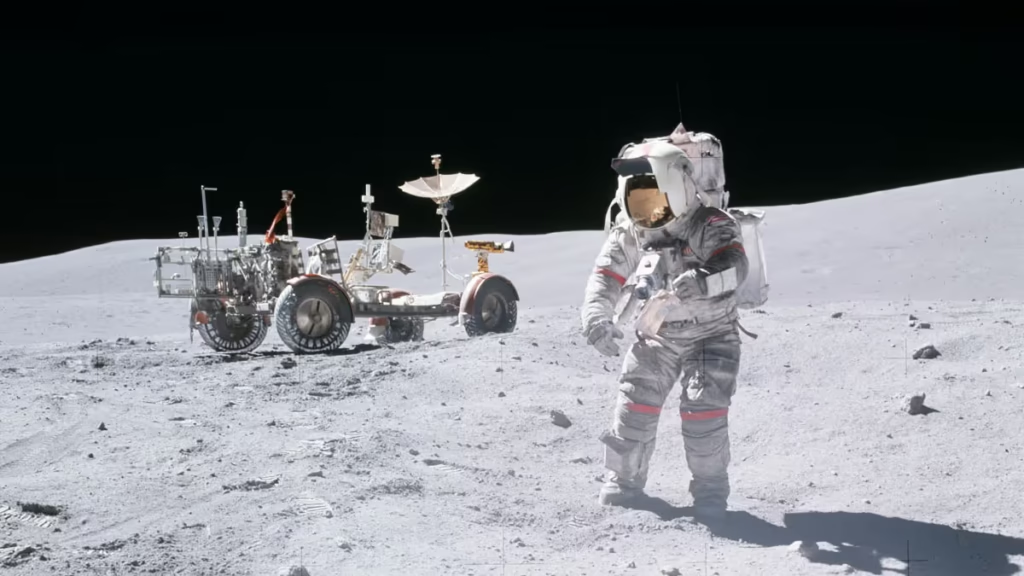
These models will support:
- Autonomous scientific discovery
- Terrain analysis and navigation
- Long-term space exploration planning
FAIMM highlights how AI is becoming mission-critical not only on Earth but also beyond it, serving as a core infrastructure layer for future interplanetary exploration.
Microsoft Commits $17.5 Billion to AI Data Centers in India
Microsoft officially announced a $17.5 billion investment in AI-specific data centers across India, marking one of the largest infrastructure commitments in the country’s tech history.
This move aligns with a broader hyperscale trend:
- Amazon: $35 billion
- Google: $15 billion
India is rapidly emerging as a global AI infrastructure hub, driven by cloud demand, AI workloads, and geopolitical diversification of compute resources.
TSMC Posts Record AI-Driven Profits
Taiwan Semiconductor Manufacturing Company (TSMC) reported a 35% jump in Q4 profits, attributing growth almost entirely to surging demand for AI chips.
Key takeaways:
- AI semiconductors are now the primary growth engine
- Demand is expected to accelerate further into 2026
- Hardware remains the bottleneck and the power center of AI expansion
This confirms that the AI boom isn’t just software-led; it is deeply rooted in silicon supply chains.
India Releases AI Impact Summit Policy Roadmap
Ahead of the February AI Impact Summit in New Delhi, the Indian government released a policy framework aimed at balancing AI-driven creativity with copyright and licensing protections.
The roadmap focuses on:
- Responsible AI innovation
- Protection of original creators
- Clear licensing norms for training data
India’s approach reflects a growing global effort to regulate AI without stifling innovation.
Bill Gates Warns of AI-Driven Bioterrorism Risks
In a high-profile statement, Bill Gates warned that AI could be exploited by non-state actors to design biological weapons, calling for urgent international cooperation on AI safety.
His message emphasized:
- The dual-use nature of advanced AI models
- The need for global safety protocols
- Collaboration between governments, researchers, and industry
This warning added urgency to ongoing debates around AI governance and misuse prevention.
Grok AI Faces Global Regulatory Investigations
xAI’s Grok came under scrutiny as regulators in the UK, Canada, and other jurisdictions launched formal investigations.

Concerns include:
- Insufficient safeguards against harmful content
- Potential generation of unlawful deepfake imagery
- Weak moderation controls
The probes highlight increasing regulatory pressure on AI companies to prioritize safety and compliance alongside innovation.
Final Thoughts: AI Becomes Global Infrastructure
This week in AI made one thing clear: AI is no longer a future technology, it is present-day infrastructure.
From autonomous coding agents generating billion-dollar businesses to nation-scale data center investments and space exploration models, AI is reshaping economies, governance, and global power structures.
The next phase won’t be about whether AI works, but about who controls it, how it’s regulated, and how responsibly it’s deployed.