




How AI is Automating the Startup Journey: From Idea to IPO
-
Avick kumar Dey / 2 months

- January 3, 2026
- 0
- 5 min read

In 2026, the startup landscape is undergoing a profound transformation. Generative AI is no longer a novelty, it’s becoming the invisible co-founder for millions of entrepreneurs. What once took teams of specialists, months of work, and significant capital can now be accelerated dramatically with AI tools. From brainstorming viable business ideas to preparing for a public debut, AI is democratizing entrepreneurship, lowering barriers, and enabling solo founders or small teams to compete with established players.
The global AI market is projected to exceed $800 billion by 2030, but its impact on startups is even more immediate. Studies show that generative AI can boost productivity by 20-40% in creative and analytical tasks, allowing founders to iterate faster and validate concepts with minimal risk. As we enter this new era, let’s explore how AI automates each stage of the startup journey from spark to stock market ringing.
Stage 1: Idea Generation and Brainstorming
The journey begins with an idea. Traditionally, this involved endless coffee-fueled sessions, market research reports, and gut instinct. Today, AI tools act as tireless brainstorming partners.
Platforms like ValidatorAI, DimeADozen.ai, and Startup.ai use generative AI to generate, refine, and score business ideas based on user inputs. Describe your skills, interests, and target market, and these tools output dozens of tailored concepts complete with market potential analysis. For instance, AI can scan trends from social media, news, and patents to suggest under-served niches think AI-powered personalized nutrition for remote workers or automated compliance tools for small e-commerce brands.
More advanced systems, like those from Y-Combinator backed startups, simulate customer personas and run virtual focus groups. Expected Parrot, for example, creates AI agents that mimic target users to test pricing strategies or feature preferences early on.
This automation means ideas that once took weeks to flesh out can now be validated in hours. Solo founders, in particular, benefit: AI fills the role of a missing co-founder, providing objective feedback and sparking creativity.
Stage 2: Validation and Market Research
Many startups fail because they build something nobody wants. AI is changing that by enabling rapid, data-driven validation.
Tools like ValidatorAI simulate launches, predict customer feedback, and analyze competitors. Generative AI crawls vast datasets to assess market size, identify pain points, and even forecast demand. ProAI generates comprehensive business plans, including SWOT analyses and financial projections.
In 2025-2026, we’re seeing AI agents that conduct automated surveys or scrape Reddit and X for real-time sentiment. This reduces the “build it and see” risk founders can pivot before investing heavily.
Research from MIT and OECD highlights how generative AI enhances entrepreneurial decision-making by providing contextual insights and opportunity identification. Entrepreneurs using these tools report higher confidence in their ideas, with validation cycles shrinking from months to days.
Stage 3: Product Development and MVP Building
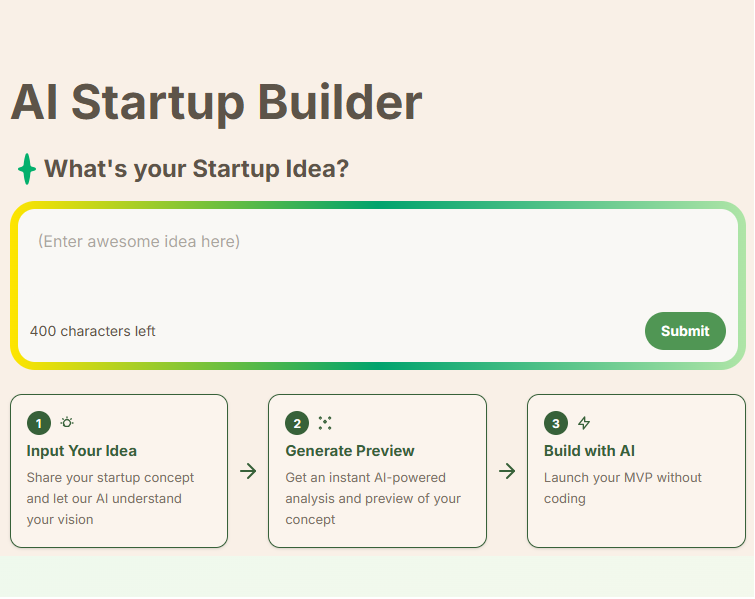
Building a minimum viable product (MVP) used to require coding expertise or outsourcing. Now, AI handles much of the heavy lifting.
No-code platforms enhanced with AI, like a0.dev or x1, allow founders to describe apps in natural language and generate functional code. GitHub Copilot and Cursor (valued at $2.5 billion) assist developers with real-time suggestions, cutting development time by up to 50%.
For non-technical founders, tools like Runway or Synthesia create video demos and prototypes instantly. Robotics and hardware startups benefit too Hlabs provides plug-and-play AI components for rapid prototyping.
The result? AI-native startups launch MVPs in weeks, not quarters. This speed enables quicker user feedback loops, essential for Lean Startup methodologies.

Stage 4: Marketing, Sales, and Growth
Once the product exists, acquiring users is the next hurdle. AI excels here.
Jasper and similar tools generate blog posts, social media content, and ad copy tailored to audiences. Runway produces professional videos for campaigns without a production team.
AI-driven analytics predict customer behavior, optimize pricing, and automate outreach. Tools like AirOps enhance SEO for the AI-search era, ensuring visibility on platforms like Perplexity.
Customer support? AI agents handle inquiries 24/7, freeing founders to focus on strategy. Startups using these tools report lower customer acquisition costs and faster growth critical in a competitive 2026 market.
Stage 5: Fundraising and Pitching
Raising capital remains challenging, but AI streamlines it.
PitchBob and ProAI craft investor-ready pitch decks, financial models, and executive summaries. AI analyzes thousands of successful pitches to suggest compelling narratives.
For due diligence, tools automate data rooms and forecast scenarios. In 2025, AI startups raised record funding OpenAI, Anthropic, and xAI alone pulled in tens of billions showing investors’ appetite for AI-leveraged ventures.
Stage 6: Scaling Operations and Preparing for IPO
As startups grow, operations complexity increases. AI agents from companies like Worktrace or Hippocratic AI automate workflows in HR, finance, and compliance.
For late-stage, AI handles predictive analytics, risk assessment, and even regulatory filings. Databricks and CoreWeave, AI infrastructure giants, are eyeing 2026 IPOs after massive raises.
Predictions from Sapphire Ventures and others forecast blockbuster AI IPOs in 2026, including potential debuts from OpenAI and Anthropic. These companies, built on AI foundations, demonstrate how the technology enables hyper-scaling.
The Future: Challenges and Opportunities
While AI automates much of the journey, human elements remain irreplaceable: vision, ethics, and relationship-building. Risks include over-reliance on AI (leading to generic ideas) and biases in training data.
Yet, the opportunities are immense. Generative AI is democratizing entrepreneurship enabling diverse founders from underrepresented regions to compete globally. As Yann LeCun and others note, evolving architectures like world models will push boundaries further.
In 2026, the most successful entrepreneurs won’t be those who avoid AI they’ll be the ones who master it as a partner. From idea to IPO, AI isn’t replacing founders; it’s empowering them to build bigger, faster, and smarter.